
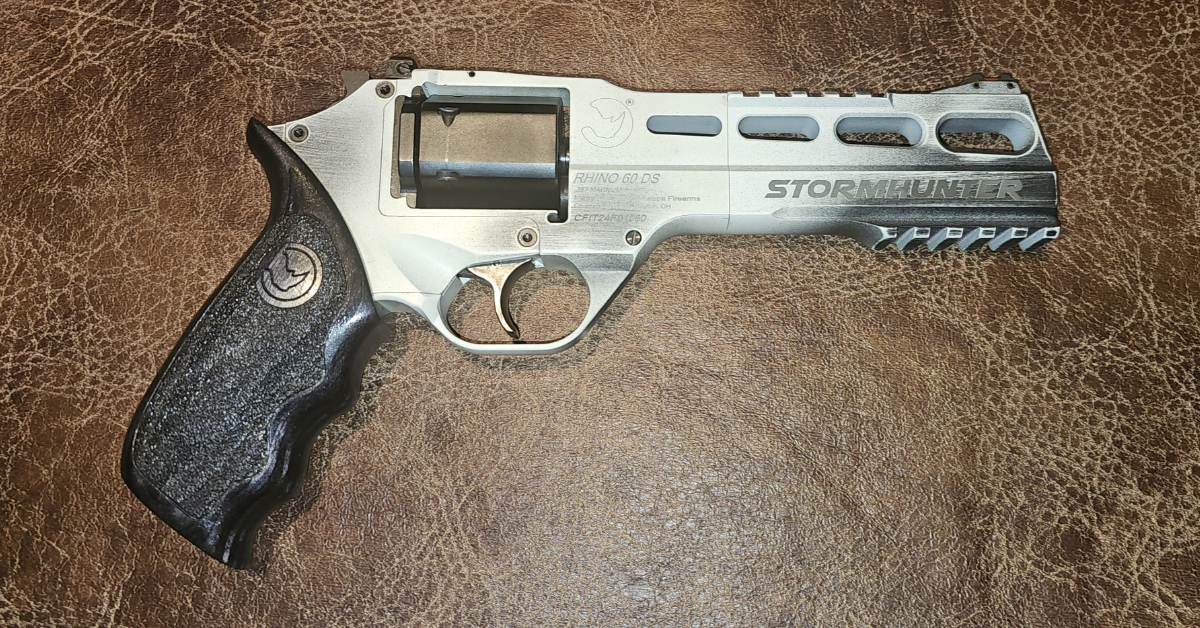
I had seen the Chiappa Rhino revolver long before I ever considered owning one. I had even shot a friend’s Rhino and remembered how smooth and easy it was to handle. Still, I always thought of the Rhino as a gimmick gun. Its unconventional design and angular lines made it stand out, but not necessarily in a way that made me want one. It simply didn’t fit the traditional revolver image I was used to, and I never seriously considered adding one to my collection.
Several months ago, I was browsing, looking for something different to own, something that stood apart from the usual additions. The Chiappa Rhino Storm Hunter 6 inch appeared on my screen. I have to admit; it was the color and design that first caught my attention. The more I looked at it, the more intrigued I became. I learned it was part of a Special Edition, which added to its appeal. When I saw it listed on sale at Palmetto State Armory for around $1,000, significantly less than other listings I had seen, the decision came quickly. There was no hesitation and, more importantly, no buyer’s remorse.
Months later, the revolver remains unfired, but I often find myself taking it out simply to appreciate its design and engineering. What began as curiosity has turned into something closer to respect. The Chiappa Rhino Storm Hunter 6oDS may not look like a traditional revolver, and it certainly challenges convention, but that is exactly what makes it worth discussing. This is not a range report. It is a closer look at a revolver that changed my perspective on what innovative design can look like in a firearm.
Quick Specs Snapshot
Before getting into the design and concept behind it, here is a quick look at the basic specifications of the Chiappa Rhino 60DS Storm Hunter.
- Caliber: .357 Magnum
- Barrel: 6 inches
- Capacity: 6 rounds
- Length: 10.5”
- Action: DA/SA
- Rear Sight: Adjustable
- Front Sight: Fiber optic
- Finish: StormHunter
- Weight: 2.06 lbs.
First Impressions
I have to go back to my first experience shooting a Chiappa Rhino. It was several years ago, but I still remember being curious about how it would feel. The revolver was heavier than I expected. It was not overly heavy, and certainly not heavier than some of my other full-size .357 revolvers. Still, given its unconventional design, I assumed it would feel lighter in the hand. That first impression stayed with me.
Now that I own the Rhino Stormhunter, I have had time to study it more closely. Plain and simple, I am impressed. The grip allows a high purchase, which makes the revolver feel secure and well controlled. The lower bore axis is obvious when you hold it. Even without firing it, you can see how the design directs recoil straight back rather than upward.
The overall construction feels solid and intentional. The Storm Hunter finish gives it a distinctive appearance. It separates the revolver from more traditional designs. I appreciate the inclusion of Picatinny rails, which allow for mounting a light or optic. Mine remains in its factory configuration, but the option is there.
There are also small details that make the Rhino stand out. The cylinder release sits near the hammer and feels unconventional at first. Once handled, it makes sense. The cocking indicator is another thoughtful addition. It is subtle, but functional. These features are not gimmicks. They are deliberate engineering choices.
The fiber optic front sight provides a clear sight picture. The double action trigger pull feels consistent and predictable. In single action, the break is light and crisp. Even during dry handling, there is a noticeable difference from traditional revolvers. The Rhino does not just look different. It feels different.
Engineering Over Tradition
The first time I handled a Chiappa Rhino, I remember thinking it looked like something from a science fiction movie. It did not resemble the revolvers I grew up seeing or shooting. The barrel sits lower. The lines are sharper. Even the cylinder profile looks and feels different.
At the time, I thought it was simply different for the sake of being different.
The more I learned about the design, the more I realized there was real thought behind it. The Rhino fires from the bottom chamber of the cylinder rather than the top. That lowers the bore axis closer to the shooter’s hand. Instead of recoil flipping the muzzle upward, the force pushes more straight back.
When I shot one years ago, that difference stood out immediately. It did not feel like a typical .357 Magnum. The recoil was firm but controlled. It tracked differently than a traditional revolver, and it stayed flatter than I expected.
The Stormhunter finish only adds to that impression. I looked at other finishes, including the Nebula, but the black and white Stormhunter design was my favorite. Regardless of the finish, the Rhino’s engineering feels purposeful. It is not trying to imitate tradition. It is comfortable standing apart from it.
The more I study this revolver, the more I respect what Chiappa set out to do. This design is not about looking unusual. It is about approaching recoil and control in a different way.
Pros and Cons
Pros
- Unique engineering concept – The bottom-chamber firing system lowers the bore axis and represents a thoughtful approach to recoil management rather than a cosmetic change.
- Noticeably reduced recoil design – Recoil impulse is more controlled and flatter than a traditional .357 revolver.
- Strong aesthetic identity – The angular lines and various types of finish give the Rhion a distinctive presence that stands apart from conventional revolvers.
- Collector appeal – The Stormhunter version, with its unique finish and limited production run, has the potential to attract collectors who appreciate distinctive or unconventional firearms.
- .357 Magnum versatility – Like other .357 revolvers, it offers flexibility with a wide range of loads, from lighter .38 Special to full-power magnum rounds.
Cons
- Polarizing appearance – The design is bold and unconventional. Some shooters will appreciate it, while others may never warm up to it.
- Not traditional revolver – The lower barrel position and angular profile break from classic revolver styling, which may not appeal to purists.
- Niche appeal – The Rhino is not aimed at the mainstream revolver market. Its design and price point limit it to buyers who value innovation or uniqueness.
- High cost – At $1,000 and above, it sits at the upper end of revolver pricing, especially for those who prefer more traditional designs.
- Limited aftermarket – Because of its unique frame and barrel alignment, holster options and accessories can be more limited compared to standard revolvers.
The Chiappa Rhino Stormhunter is not a revolver that tries to satisfy everyone. Its strengths lie in thoughtful engineering and a willingness to challenge tradition. At the same time, its unconventional design and higher price point narrow its audience. Whether it feels like an innovative masterpiece or an unnecessary departure from tradition will depend largely on what you value in a revolver.
Final Thoughts
When I first saw the Chiappa Rhino years ago, I dismissed it. It looked unusual and, at the time, unnecessary. I assumed it was designed more to stand out than to perform. Owning the Chiappa Rhino Stormhunter 6 inch has changed that perspective.
The more time I spend with it, the more I appreciate what Chiappa attempted to do. The lower bore axis is not marketing. It is a mechanical solution to recoil control. The angular design is not random. It is deliberate. Even the small details, from the cylinder release placement to the cocking indicator, reflect thoughtful engineering.
This particular Stormhunter model adds another layer. The finish is distinctive. The 6-inch configuration gives it presence. Whether it ultimately becomes widely recognized as a collectible remains to be seen, but it certainly stands apart from standard revolvers on today’s market.
Mine remains unfired. That may change someday. For now, I appreciate it for what it represents. It is a revolver that challenges convention and rewards those willing to look past tradition. It may not be for everyone, but it has earned its place in my collection.
Related Content

Although I’ve always appreciated the revolver, something recently reignited my interest. Over the past few weeks, I’ve taken a deeper dive into this wonderful firearm;
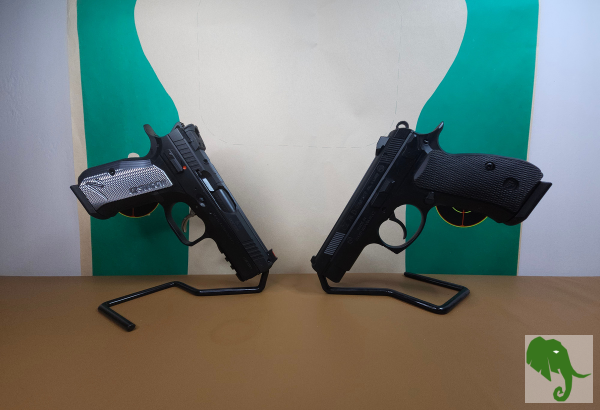
Comparison of the CZ Shadow 2 Compact and 75D PCR Compact
During one of my many visits to the local firearms store, I picked up the CZ Shadow 2 Blue in a spontaneous purchase. I was…
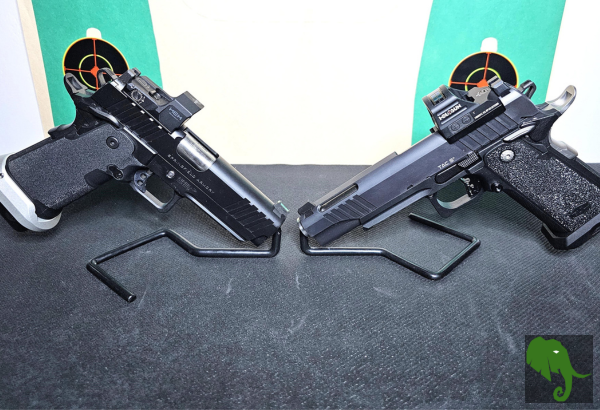
Comparison of the Springfield DS Prodigy 4.25 and Bul Armory SAS II TAC 5
Not too long ago, I got the itch to own a premium pistol, particularly a 2011-style firearm. I considered several well-respected manufacturers like …
Comparison of the Beretta M9A4 and Sig Sauer P320-M17
As a Marine veteran, I’ve trusted duty pistols like the Colt M1911A1, which I carried in Beirut in 1984 during its tenure as the Corps’…
Fusion XP Pro: A Quality 2011 Without the Sticker Shocks
Continuing my exploration of quality DS 1911s, better known today as 2011-style pistols, I came across a unique offering: the Fusion…

Read other OwnGuard Solutions blog posts
Read our other posts centered around being safer and better prepared.
Classes and Training

Register for one of our upcoming, scheduled classes or request one that is not currently scheduled.